
Shop by Brand
Tank Eductors
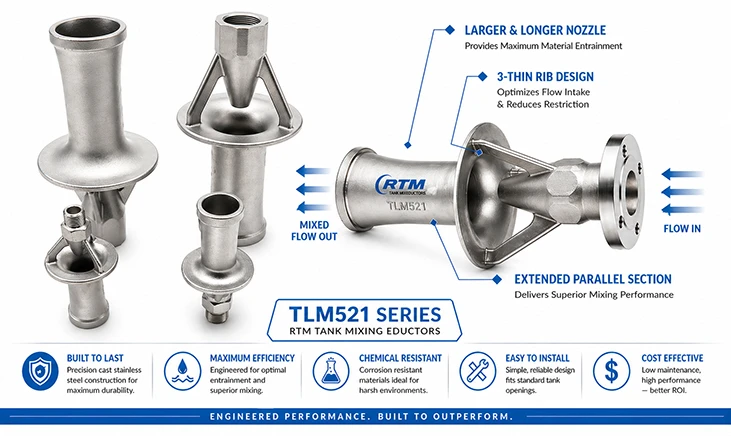
Tank Mixing Eductors: A Professional Guide
Tank mixing eductors (also known as tank liquid agitators or jet mixers) are efficient, non-mechanical devices used to agitate, blend, and circulate liquids inside tanks or vessels. They rely on the Venturi principle to create powerful mixing without moving parts, making them ideal for industries requiring uniform solutions, suspended solids, or chemical distribution.
This guide provides a clear, step-by-step overview to help engineers, plant operators, and maintenance teams understand, select, install, and maintain eductors for optimal performance.
How Tank Mixing Eductors Work
A recirculating pump supplies pressurized liquid (the motive or inlet flow) to the eductor’s nozzle. As this fluid exits at high velocity, it creates a low-pressure zone in the flow-through chamber (Venturi effect). This draws in surrounding tank liquid (the entrained or suction flow, —typically 3–5 times the motive flow). The combined stream is discharged as a high-volume plume that circulates the tank contents.
Key ratios (at typical 10–50 psi / 0.7–3.5 bar):
- Entrainment: 3–5x the pumped volume
- Total circulation: 4–6x the inlet flow
Key Benefits
Tank mixing eductors outperform traditional methods like pipes with holes, mechanical agitators, or air sparging in many applications:
- Uniform mixing — Consistent temperature, pH, chemical distribution, and solids/gas dispersion for better product quality.
- Energy & cost savings — Smaller pumps circulate large volumes (up to 5x amplification), reducing purchase and operating costs.
- Low maintenance — No moving parts; inherently non-clogging with large flow passages.
- Clean operation — Eliminates oil contamination or ventilation issues from compressed air.
- Versatile — Handles viscous fluids, slurries, and particulates; easy to install inside tanks.
Essentially, the eductor uses the energy of a pumped fluid to entrain and mix a much larger volume of the tank's contents, providing efficient agitation, preventing stratification, and ensuring uniform distribution of substances.
| Type | Inlet Flow Range | Typical Use | Key Features |
|---|---|---|---|
| Standard (e.g., 46550) | 3.5–75 gpm (13–308 L/min) | Medium-to-large tanks | Large passages; 4x entrainment; compact |
| Mini | 0.31–2.9 gpm (1–12 L/min) | Small tanks & low-flow applications | Color-coded; ideal for plating/etching |
| Air-Induced | 0.82–3 gpm + air | Enhanced cleaning with bubbles | Scrubbing action; particulate capture |